


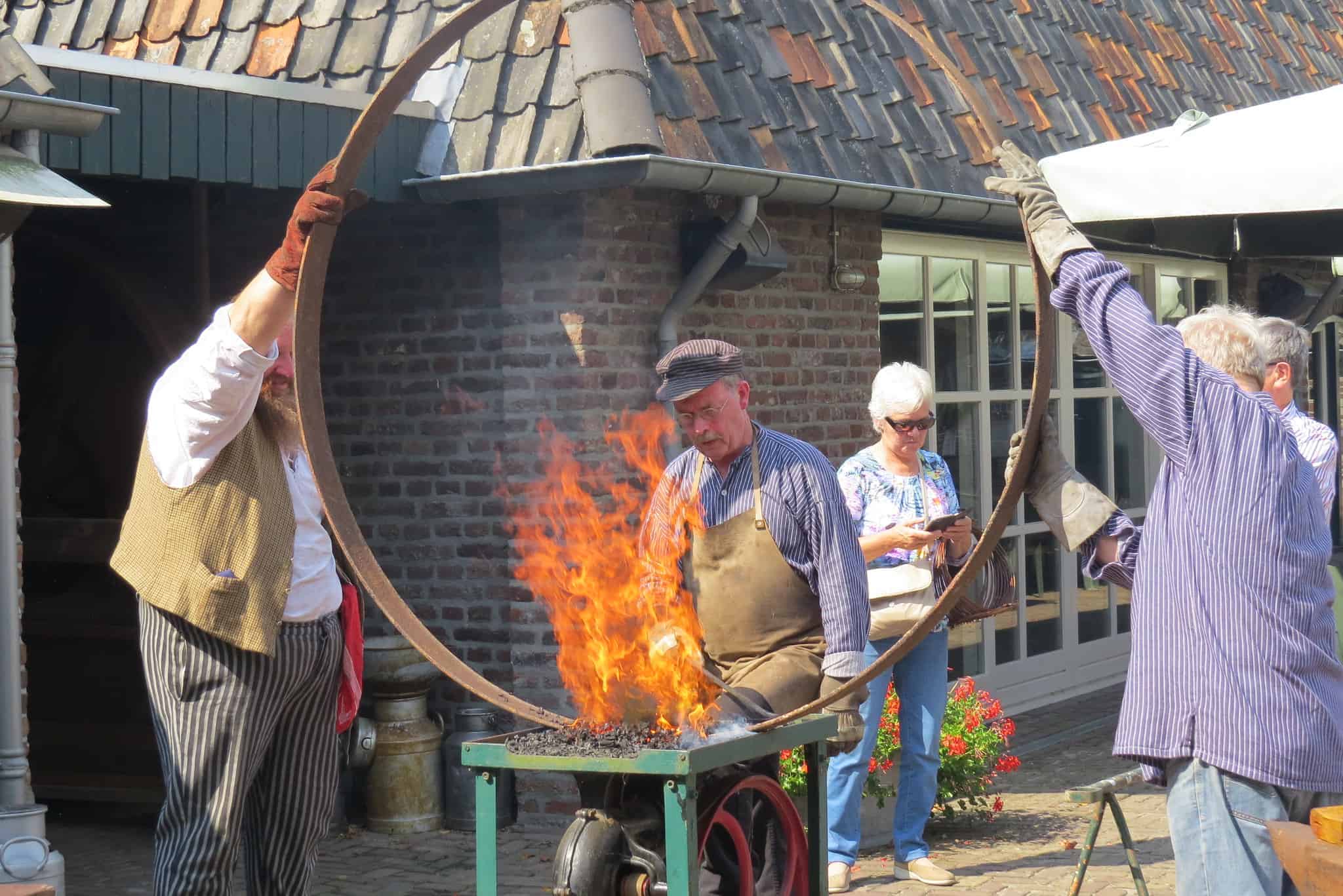
The councilmaker and wheelwright may be two different professions: they built carts, wagons and carriages together. Sometimes in the same workshop.
Making a wheel with spokes required special craftsmanship. For the spokes, straight-grained oak was selected from which these spokes were split, never sawn. It was important that the wood was very dry. Therefore, the spokes were laid out to dry for several years before they were further finished and applied. The finishing was done with a cutting knife. The spokes were given an oval cross-section, round at one end with a slot in which a wedge could be driven into the rim after attachment. The other end square.
The number of spokes per wheel could vary; usually there were twelve. The middle part of the wheel, the dom, was turned on a special lathe. Then the holes for the spokes in the cathedral were cut out into which the ends of the spokes were inserted.
Finally, the rim segments were carefully hammered onto the twelve spokes, a wedge was driven into the end of the spoke for reinforcement. Then the wheel was taken to the blacksmith who put a red-hot iron band around it, which shrank during cooling and was so tight around the wheel that the tire would not come off. Finally, a hole was drilled through the cathedral. A tapered bushing was installed in which the shaft later had to turn. The ashes, like the bus, were bought ready-made.