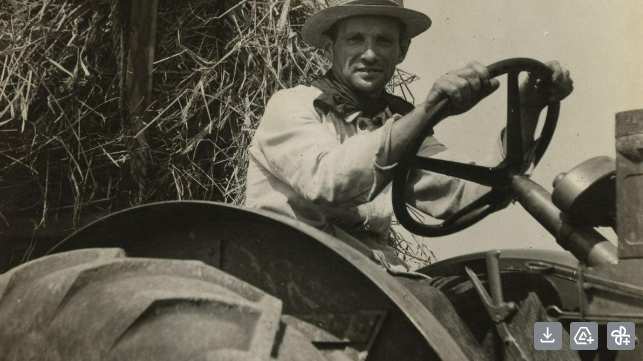
The exhibition showcases the developments of 125 years in the Limburg countryside. The connection with the rich Catholic life, and its decline, are also addressed.
The reason: around 1890, we were dealing with an agricultural crisis that demanded the utmost from the agrarian society. It was realized that cooperation could contribute to a possible solution. In the period 1890–1910, several cooperative organizations were established: the dairy industry (including numerous small butter factories), the Farmers’ Credit Banks, the Vegetable and Egg Auction, the Farmers’ Unions, and the Limburg Agricultural and Horticultural Union, among others, the later LLTB.
In a relatively short period of 20 years, a great deal happened in the region of inward-looking villages with poor infrastructure, no radio, hardly any newspapers, and almost no agricultural education: a tremendous achievement!
The aforementioned organisations were among the pillars upon which the prosperity that began in 1910 rested. The Cooperative Farmers’ Loan Bank made it possible to finance the many new developments. The small butter factories grew into steam dairy factories and are today all united in Campina-Friesland. The Farmers’ Union appeared in almost every village. This association purchased, for example, chicken feed and artificial fertilizer in bulk for its members. It also bought expensive agricultural machinery that members could borrow. And the Farmers’ Union shop started selling garden supplies, among other things. We now know the Farmers’ Union under the name ‘Welkoop’. The cooperative auctions promoted the sale of agricultural and horticultural products. And five years after its establishment, the egg market in Roermond was the largest in the Netherlands. Emancipation also played a role; for example, women farmers’ unions were established that organised training and courses for women.
The result: Limburg grew into a prosperous province in the Netherlands, and the small butter factories served as a model for the Netherlands. North Limburg became the second-largest horticultural region in the Netherlands, is home to one of the largest auctions in Western Europe, and agricultural training programs emerged throughout the entire province. In the wake of the auction, exports increased significantly, and North Limburg now ranks among the top 5 for goods transport in the Netherlands. Today’s Limburg farmers and market gardeners are well-educated.
Al met al een rijke oogst van schrale grond!